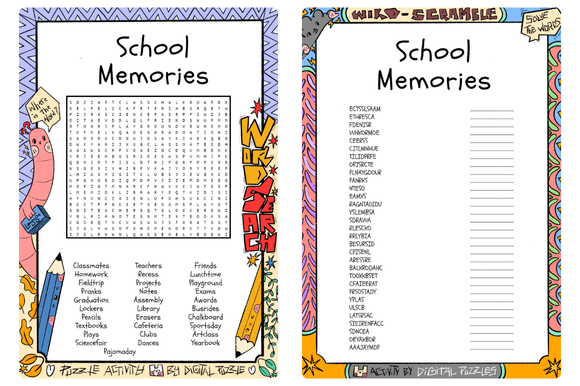
School Memories Word Search Scramble P: A Practical Tool for Educational Workflows
In the landscape of educational resources, few tools offer the seamless blend of nostalgia and cognitive engagement found in the School Memories Word Search Scramble P. For educators, parents, tutors, and content creators managing learning environments for children in 2nd through 5th grade, this resource represents more than a simple pastime. It is a structured instrument designed to integrate memory enhancement, vocabulary retention, and problem-solving skills into a cohesive learning process. Whether you are planning a semester curriculum, designing a summer enrichment program, or seeking a reliable activity for a quiet afternoon, understanding how to implement these worksheets effectively can transform a casual activity into a strategic educational asset.
The value of the School Memories Word Search Scramble Puzzle Worksheets lies in their ability to bridge the gap between passive consumption and active recall. In a workflow focused on literacy development, these puzzles serve as a critical checkpoint. They allow learners to revisit key terminology associated with school life—subjects, supplies, activities, and traditions—while engaging the brain's pattern recognition centers. By treating this resource as a deliberate step in a broader educational strategy, adults can ensure that screen-free time remains productive and aligned with developmental goals.
Integrating Puzzles into the Learning Lifecycle
To maximize the utility of the School Memories Word Search Scramble P, it is essential to view its application within the context of a complete learning cycle. This involves preparation, execution, and review phases. When used correctly, these worksheets fit naturally before, during, or after specific instructional units or project milestones.
Pre-Activity Preparation and Priming
Before diving into a new unit about "The School Year" or "Classroom Responsibilities," these puzzles can act as an effective priming mechanism. In the planning phase of a lesson, an educator might select a specific worksheet to activate prior knowledge. Presenting the word list before the actual search begins allows the child to familiarize themselves with the spelling and context of terms like "library," "cafeteria," or "homework." This pre-loading of information reduces cognitive load during the main activity, allowing the learner to focus on the mechanics of the scramble and search rather than decoding unfamiliar words. For home-schooling parents, this serves as a low-stakes warm-up that sets a positive tone for the day's academic work.
During Execution: Active Engagement
Once the activity begins, the School Memories Word Search Scramble Puzzle Worksheets function as a sustained attention exercise. Unlike digital distractions, the tactile nature of paper-based puzzles encourages deep focus. During the execution phase, the child must scan rows and columns, identify letter patterns, and unscramble jumbled sequences. This process engages working memory and visual processing skills simultaneously. For a tutor managing multiple students, these worksheets provide a period of independent work where each child progresses at their own pace, freeing the instructor to provide targeted support to those who need it most. The consistent structure of the puzzles ensures that the activity remains manageable without requiring constant supervision.
Post-Activity Review and Reinforcement
The final stage of the workflow is arguably the most critical for long-term retention: the review process. Each package includes solutions, which transforms the puzzle from a solitary game into a self-assessment tool. After completing the task, the learner compares their answers against the provided key. This immediate feedback loop is vital for error correction. If a word was missed or scrambled incorrectly, the student can analyze why—was it a spelling issue, a scanning error, or a misunderstanding of the term? This reflection solidifies the learning outcome. Furthermore, discussing the completed puzzle allows for a natural conversation about the themes involved, reinforcing the vocabulary in a conversational context.
Workflow Compatibility and Resource Integration
One of the strengths of the School Memories Word Search Scramble P is its compatibility with existing educational ecosystems. These worksheets do not exist in a vacuum; they interact seamlessly with other tools, methods, and platforms used by educators and families.
- Curriculum Alignment: The vocabulary embedded in these puzzles often aligns with standard language arts curricula for grades 2 through 5. Educators can map specific puzzles to weekly thematic units, ensuring that the activity supports current learning objectives rather than serving as a disconnected diversion.
- Digital-Hybrid Models: In modern workflows that blend physical and digital learning, these printable assets offer a necessary counterbalance to screen time. After a session of online reading or interactive math software, transitioning to a physical word search provides a sensory break while maintaining cognitive engagement.
- Assessment Tools: For small business owners running tutoring centers or educational camps, these worksheets can be integrated into progress tracking systems. Completed puzzles can be collected as evidence of skill acquisition, specifically regarding spelling accuracy and attention to detail.
- Collaborative Projects: While often used individually, the puzzles can be adapted for group work. Students can work in pairs to solve the scramble, fostering communication and peer-to-peer teaching. This interaction enhances social skills alongside academic ones.
The versatility of the School Memories Word Search Scramble Puzzle Worksheets means they can be deployed in various settings, from formal classrooms to informal playdates. Their design accommodates different learning speeds, making them an inclusive tool for diverse groups. The inclusion of solutions further simplifies the logistics for busy professionals who may not have time to verify every answer manually, ensuring quality control without adding administrative overhead.
Practical Implementation Strategies
Successfully integrating these puzzles into your routine requires a bit of strategic planning. Here are practical tips for optimizing the use of the School Memories Word Search Scramble P:
1. Establish Clear Objectives
Before handing out the worksheet, define the goal. Is the primary aim to improve spelling, increase focus, or simply provide a relaxing break? Communicating this intent to the child helps them approach the task with the right mindset. For example, if the goal is spelling, emphasize checking each letter carefully. If the goal is speed, encourage efficient scanning techniques.
2. Create a Consistent Routine
Consistency drives habit formation. Incorporate these puzzles into a regular schedule, such as a "Friday Fun" segment or a morning warm-up. When children know what to expect, resistance decreases, and engagement increases. Over time, the anticipation of the puzzle becomes part of the learning culture.
3. Leverage the Solution Key Effectively
Do not treat the solution key merely as an answer sheet. Use it as a teaching moment. If a child struggles with a specific word, use the key to highlight the correct spelling and discuss its meaning. This turns a mistake into a learning opportunity, enhancing the overall value of the resource.
4. Organize for Efficiency
For educators managing large volumes of materials, organization is key. Keep the worksheets sorted by difficulty level or theme. Labeling folders by grade level (2nd through 5th) ensures quick access when planning lessons. This systematic approach saves time and reduces stress during busy periods.
Quality Control and Long-Term Value
When selecting educational resources, quality control is paramount. The School Memories Word Search Scramble Puzzle Worksheets are meticulously crafted to ensure age-appropriate challenges. The progression from 2nd to 5th grade reflects a thoughtful scaling of difficulty, preventing frustration while avoiding boredom. This attention to detail ensures that the resource remains relevant throughout several years of a child's development.
Long-term use of these puzzles contributes to the gradual improvement of core cognitive skills. Regular exposure to word searches and scrambles strengthens neural pathways associated with pattern recognition and linguistic processing. Over months and years, these incremental gains accumulate, resulting in improved reading fluency and spelling proficiency. For parents and educators investing in a child's future, the return on investment is clear: a fun, accessible tool that delivers measurable educational benefits.
Furthermore, the durability of the printed format means these resources can be reused across multiple cohorts or saved as keepsakes. Completed worksheets can be archived to track progress over time, providing tangible evidence of growth. This archival capability adds another layer of value, transforming simple paper activities into a historical record of a child's learning journey.
Conclusion: Unlocking Joy Through Structure
The School Memories Word Search Scramble P offers a unique proposition: the fusion of amusement and education within a structured framework. By approaching these worksheets as integral components of a larger educational workflow, adults can unlock their full potential. From initial preparation and active engagement to post-activity review, every step of the process is designed to enhance memory skills and problem-solving abilities.
Whether you are a professional educator refining a curriculum, a parent seeking meaningful activities, or a content creator looking for high-quality resources, these puzzles provide a reliable foundation. They fit seamlessly into real-world scenarios, supporting diverse learning styles and schedules. With included solutions and a design tailored for curious minds in 2nd through 5th grade, the School Memories Word Search Scramble Puzzle Worksheets set the stage for a fun-filled path of discovery. By implementing these tools with intention and consistency, you ensure that learning remains an enjoyable and rewarding experience for every child.